March 16, 2016 · 7 min read
Large Data with Scikit-learn - Boston Meetup
By Alexis Perrier
Large Data with Scikit-learn
-
Alexis Perrier - @alexip
-
Data & Software - @BerkleeOnline - Day
-
Data Science contributor - @ODSC - Night
Plan
- What is large data?
out-of-core, streaming, online, batch?
-
Algorithms
-
Implementation
-
Examples
Cannot fit in the main memory (RAM)
2-10Gb makes the computer swap too much. Slow!
From in-memory to on-disk
- Being able to work with data that fits on disk on a single machine with no cluster
- Dato: GraphLab create
- H20.ai
- memory optimized AWS instances
- pySpark MLlib
- Text: Gensim [py]
- R: SGD streaming package
- Out-of-core / External memory
Data does not fit in main memory => access data stored in slow data store (disk, ...), slower (10x, 100x)
-
Offline: all the data is available from the start
-
Online: Serialized. Same results as offline. Act on new data right away
-
Streaming Serialized. limited number of passes over the data, can postpone processing. "old" data is of less importance.
-
Minibatch, Serialized in blocks
-
Incremental = online + minibatch
clf = Some Model or Transformation
- Train on training data X_train, y_train
clf.fit(X_train,y_train)
- Predict on test data: X_test => y_test
y_test = clf.predict(X_test)
- Assess model performance on test: y_truth, vs y_test
clf.score(y_truth, y_test, metric = ...)
- Predict on new data: \( \hat{y} = clf.predict(X_{new}) \)
-
Split the training data in blocks: mini-batch (sequential, random, ...)
-
Load each block in sequence
-
Train the model adaptively on each block
-
Convergence!
- Batch size n
- split the data in N blocks
- .partial_fit instead of .fit
clf.partial_fit(X_train(i),y(i), all_classes)
- All possible classes given to partial_fit on first call
- i = 1..N number of blocks
II Algorithms
| Regression | Classification | |
| Stochastic Gradient (1) | X | X |
| Naive Bayes (2) | X |
(1) SG + PassiveAggressive + Perceptron (clf only)
(2) NB: MultinomialNB, BernoulliNB
| Clustering | Decomposition | |
| MiniBatchKMeans | X | X |
| DictionaryLearning, PCA | X |
<script type="text/template">
<!-- .slide: data-background="#FFFFFF" -->
Stochastic Gradient - Wiener filtering
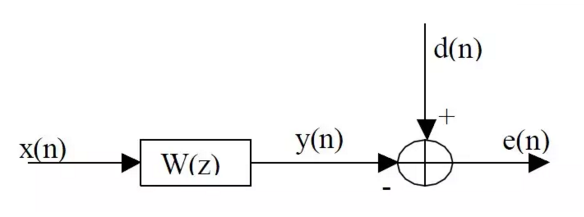
Gradient Descent solves
Deterministic!
<script type="text/template">
<!-- .slide: data-background="#FFFFFF" -->
SGD / LMS:
Approximate the gradient one sample at a time \( x_i, y_i \)
- Slow convergence
- Poor approximation of Gradient => oscillations
Mini-batch SGD / Block-LMS
N sample at a time to estimate the gradient
Less gradient noise, better convergence than SGD, still very optimizable
- GD: loss = MSE
- Passive Aggressive: Hinge loss
- Perceptron: loss = +/- 1
D. Sculley @Google, 2010, Web Scale K-Means Clustering
- Each mini-batch
- Each sample \( x \) in the batch
- Find closes center \( C_{x} \) (min dist)
- Each sample \( x \) in the batch
- Update \( C_{x} \) with
- Each sample \( x \) in the batch
Same convergence level
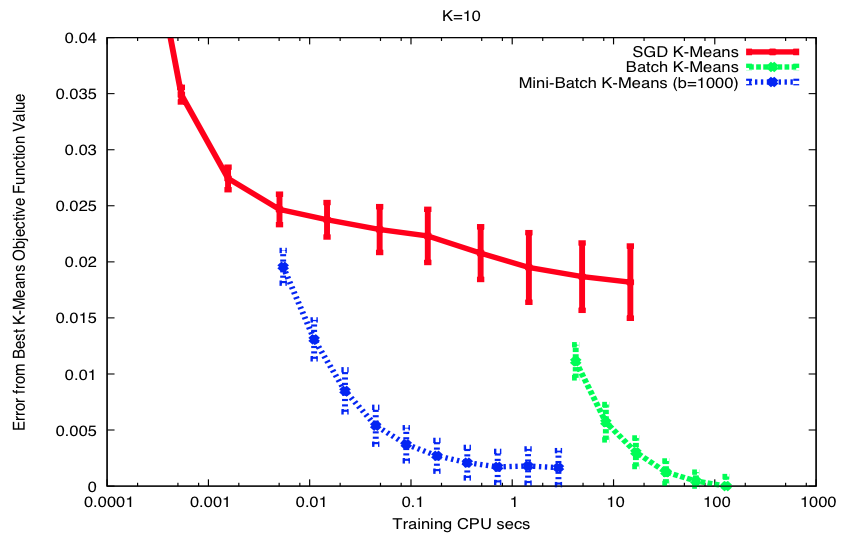
-
Classification: Mini-batches need to be balanced for classes
-
Perceptron, PA and SGD put different emphasis on samples over time.
-
Batch size influences?
- time efficiency of training (small batch) VS noisiness of gradient estimate (large batch)
Adding some noise (small batch) can be interesting to get out of local minimas
In practice
- small to moderate mini-batch sizes (10-500)
- decaying learning rate
III Examples
Not same partition as K-Means, but much faster
Same convergence level
Batch sizes: 100, 500, 2000
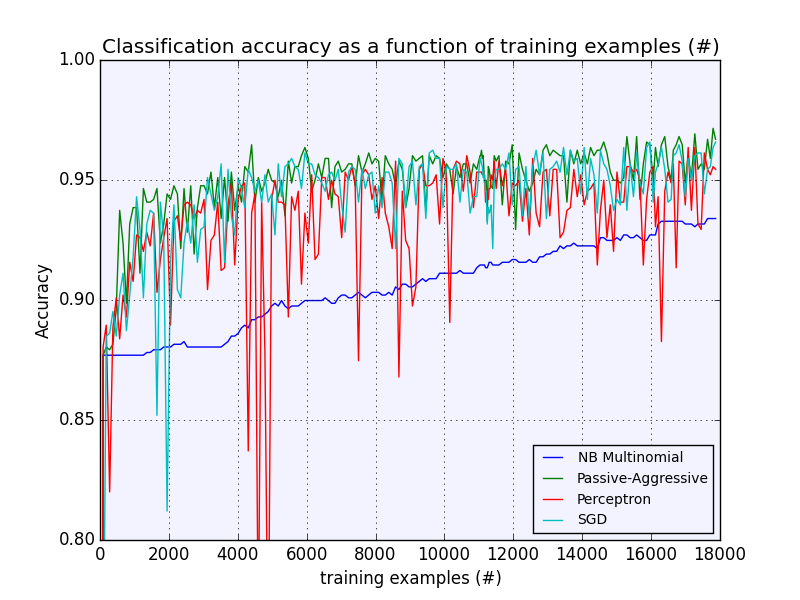
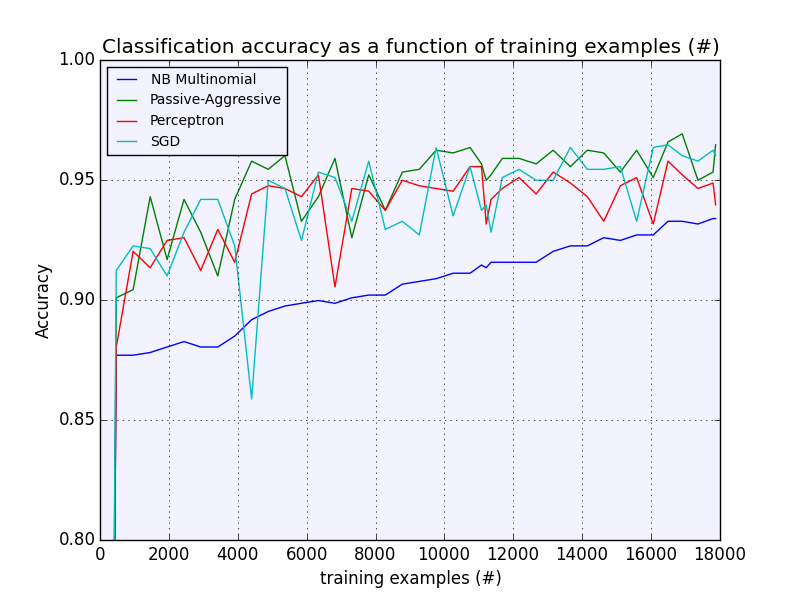
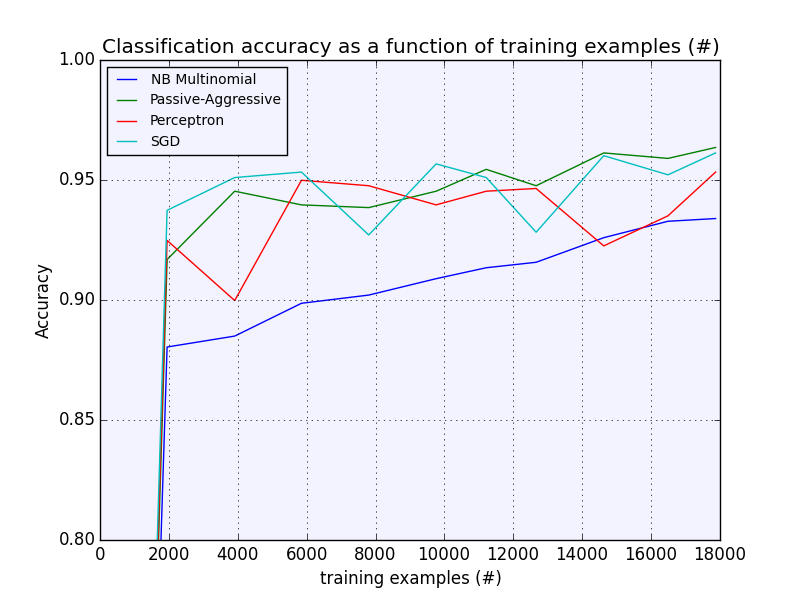
Accuracy results are similar
Batch sizes: 100, 500, 2000
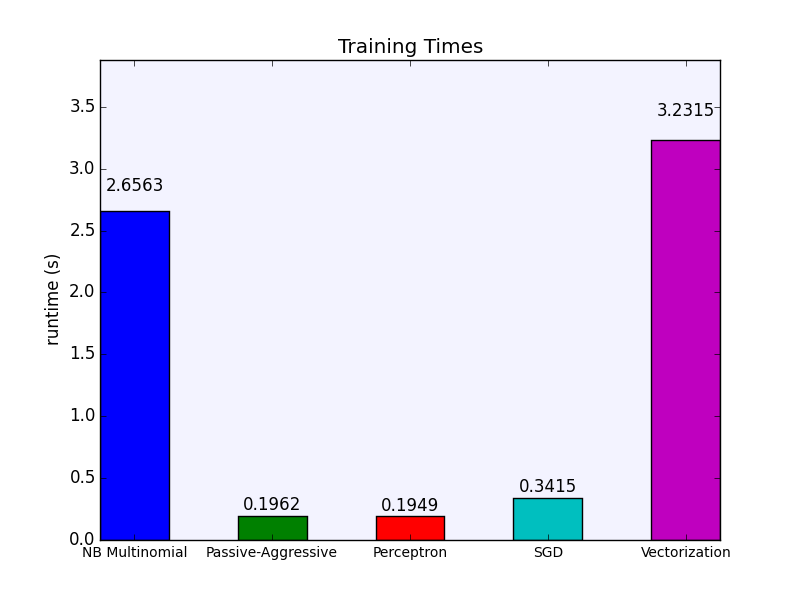
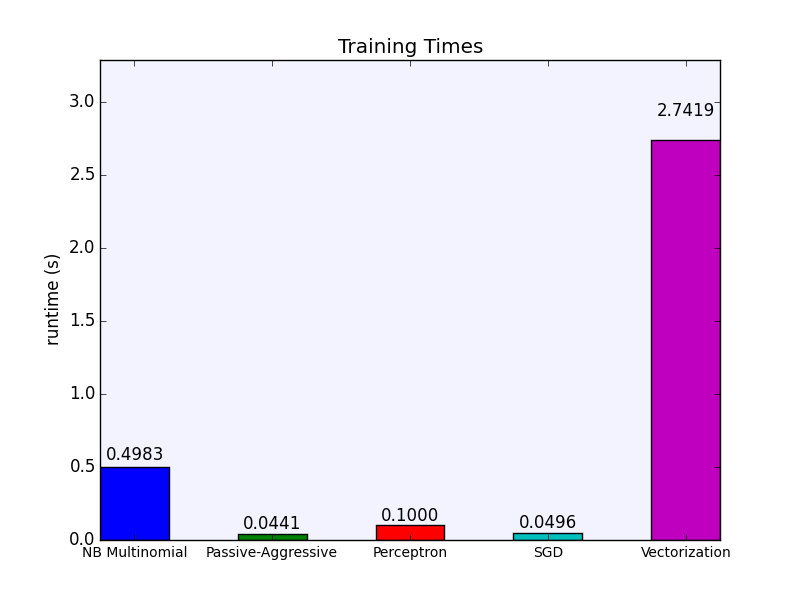
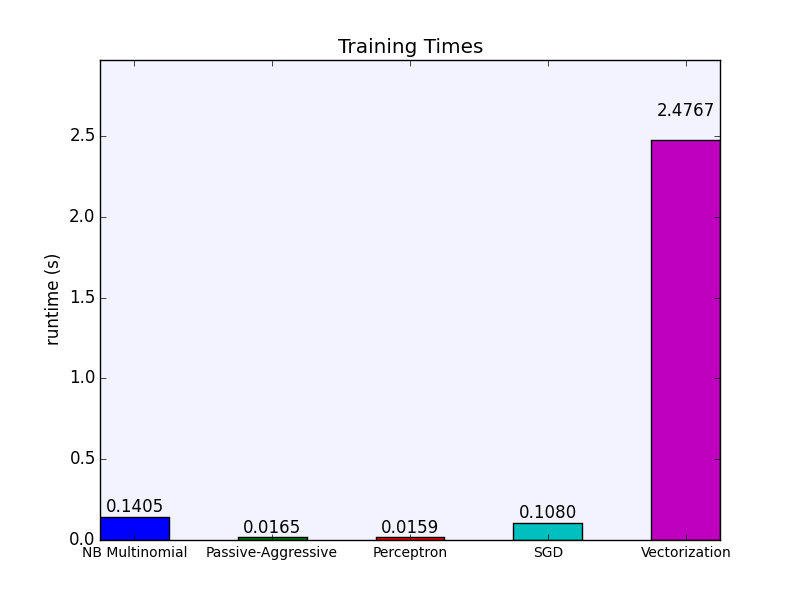
Stays basically the same for vectorization
feature extraction, vectorization: TfIdf / Hashing Trick
10k training 4k test
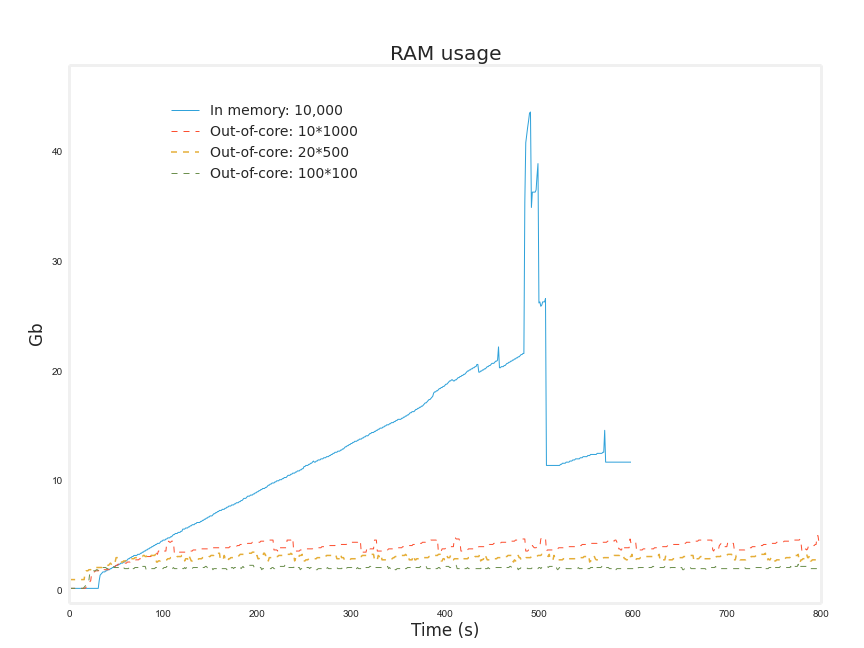
10k pages, 500 batch size, 100 iterations
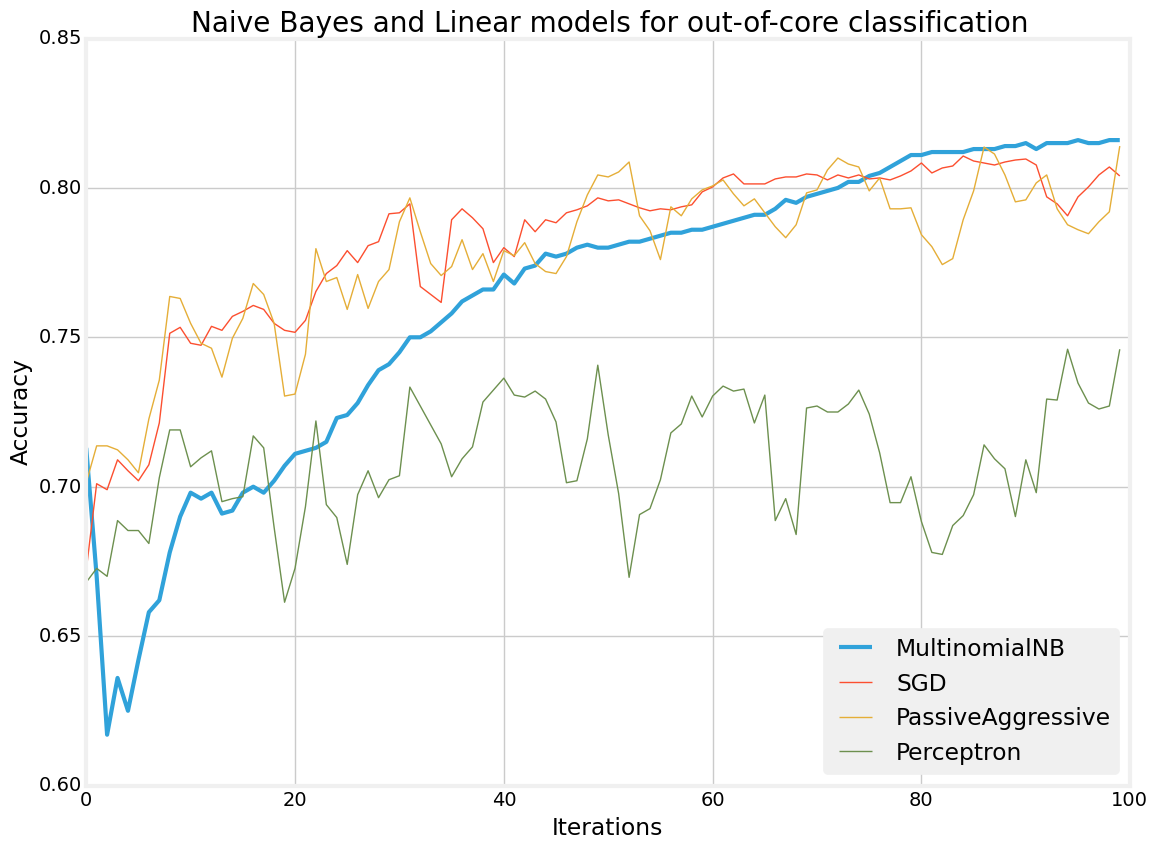
NB steadily converges,
SGD, PA, Perceptron: unstable
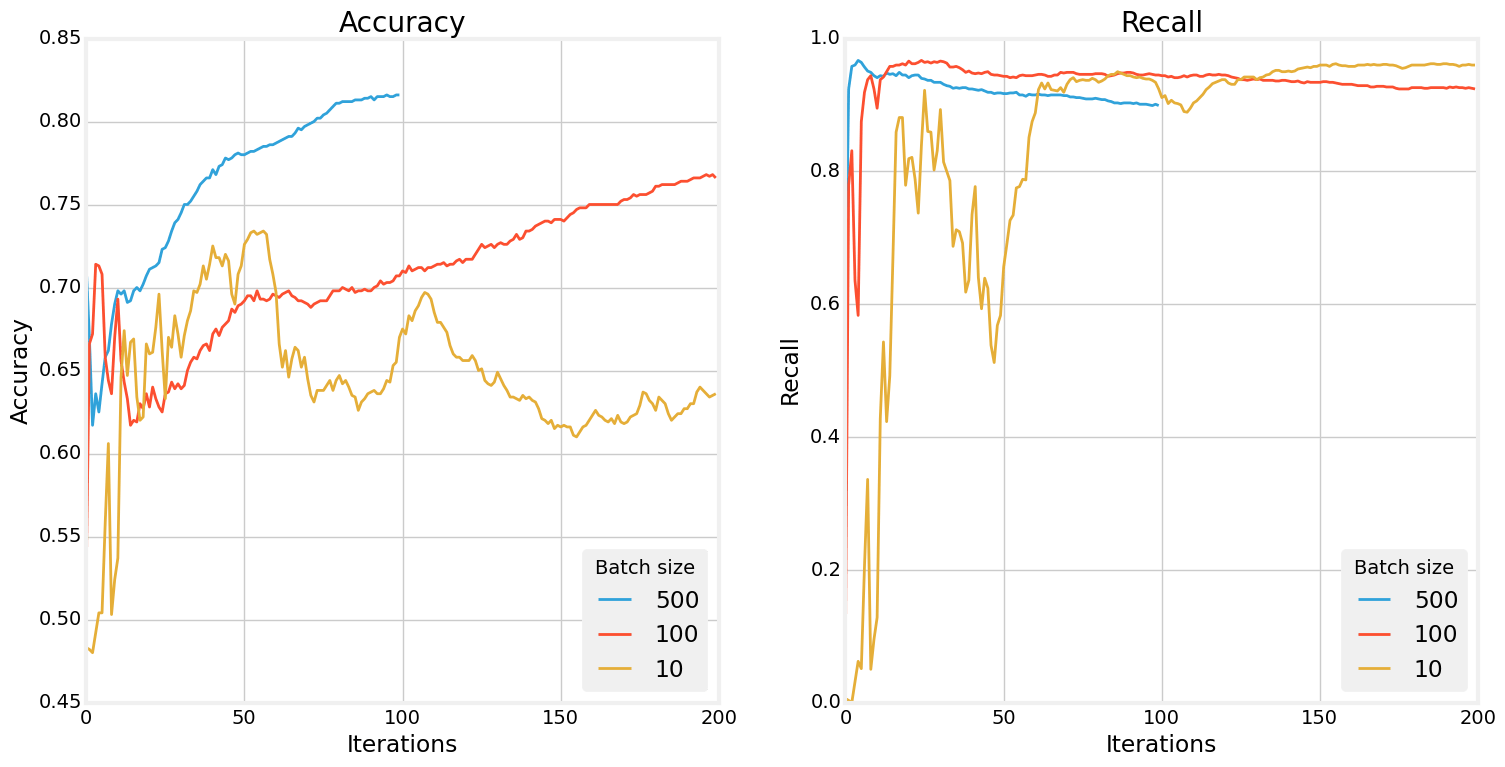
Naive Bayes, Batch size: 10, 100 and 500
- Loading csv files
- Parsing, segmenting,
- word counts, TfIdF, hashing vectorizer
=> time consuming
@alexip
-
https://scikit-learn.org/stable/modules/scaling_strategies.html
-
Memory imprint of Python Dict https://blog.scrapinghub.com/2014/03/26/optimizing-memory-usage-of-scikit-learn-models-using-succinct-tries/
-
Dask https://github.com/dask/dask-examples/blob/master/nyctaxi-2013.ipynb
-
scikit learn https://fa.bianp.net/talks/sheffield_april_2014/#/step-19
-
https://scikit-learn.org/stable/modules/generated/sklearn.linear_model.SGDClassifier.html
-
https://github.com/szilard/benchm-ml/blob/master/0-init/1-install.txt
-
https://stackoverflow.com/questions/15036630/batch-gradient-descent-with-scikit-learn-sklearn