Let's practice Windows functions
dataset
We'll work on the normalized version of the trees db
-
download the sql backup from https://skatai.com/assets/db/treesdb_v03_normalized.sql
-
restore the database
from the terminal
psql -d postgres -f <path to the sql backup>/treesdb_v03_normalized.sql
or within a PSQL session
\i <path to the sql backup>/treesdb_v03_normalized.sql
This will create a new database called treesdb_v03_normalized
Explore
Check out the tables, make a few queries to get a sense of the data.
The ERD is
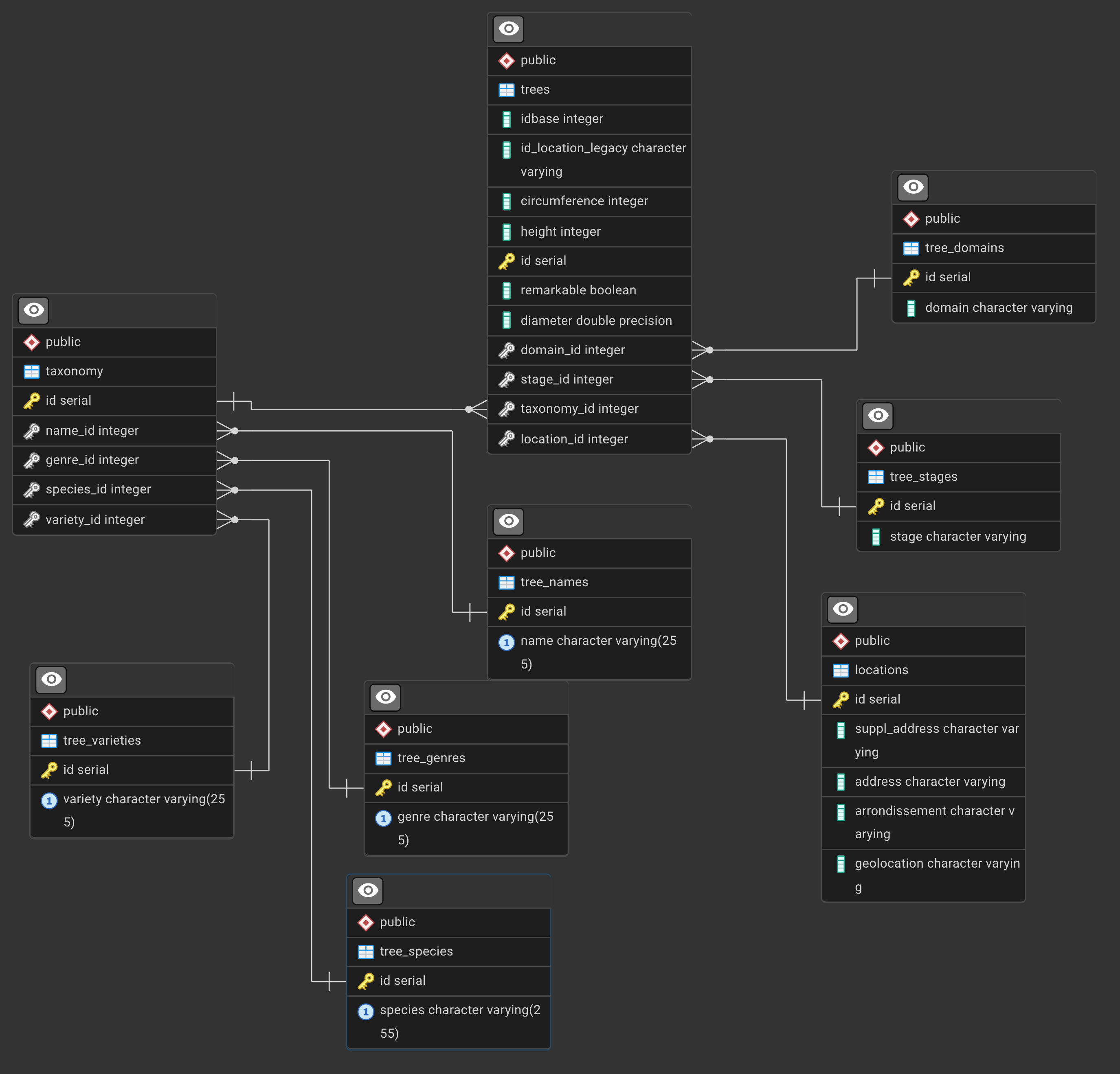
Window Functions Exercises - Paris Trees Database
Level 1: Basic Data Exploration with Window Functions
Exercise 1.1: Understanding the Overall Dataset
Why: Before diving into analysis, we need to know: How many trees do we have? How many are missing critical measurements? What's the data quality like?
Goal: Show overall counts and percentages of NULL values for key measurements.
Hint: Use COUNT(*) OVER() for total trees, and COUNT(column) OVER() for non-null counts. Calculate percentages by dividing counts.
Compare with
GROUP BYandCOUNT(*)sql queries to see the difference.
Query Structure:
SELECT
    -- Show a sample of tree IDs
    -- Calculate total trees using window function
    -- Count non-null heights
    -- Count non-null circumferences
    -- Calculate percentage of trees with height data
FROM trees
LIMIT 10;
Key Insight: All rows show the same totals because window functions without PARTITION BY operate on the entire dataset.
Exercise 1.2: Data Quality by Arrondissement
Why: Paris has 20 arrondissements, the dataset also includes surrounding parks. We want to understand if data quality varies by location - are some districts better at recording tree measurements?
Goal: For each arrondissement, count total trees and trees with valid measurements (height > 0).
Hint:
- Join with locations table to get arrondissement
- Use PARTITION BY arrondissement
- Filter WHERE height > 0 to exclude zeros and nulls
- Use COUNT(*) vs COUNT(CASE WHEN...) to compare totals
Query Structure:
SELECT DISTINCT
    l.arrondissement,
    COUNT(*) OVER(PARTITION BY ...) AS total_trees,
    -- Count trees where height > 0 within each arrondissement
    -- Calculate percentage
FROM trees t
JOIN locations l ON ...
WHERE l.arrondissement IS NOT NULL
ORDER BY ...;
Key Insight: Using DISTINCT gives us one row per arrondissement. We see which districts have better data quality.
note using window functions and
distinctis overkill. A more simple way to get the results is simply to usegroup byandcount
For instance
SELECT
    l.arrondissement,
    COUNT(*) AS total_trees,
    COUNT(CASE WHEN t.height > 0 THEN 1 END) AS trees_with_valid_height,
    ROUND(
        COUNT(CASE WHEN t.height > 0 THEN 1 END)::numeric /
        COUNT(*) * 100,
        2
    ) AS pct_valid_height
FROM trees t
JOIN locations l ON t.location_id = l.id
WHERE l.arrondissement IS NOT NULL
GROUP BY l.arrondissement
ORDER BY l.arrondissement;
But for the sake of the exercise, try to write the query using window functions and distinct.
You should get this result:
  arrondissement   | total_trees | trees_with_valid_height | pct_valid_height
-------------------+-------------+-------------------------+------------------
 BOIS DE BOULOGNE  |        4143 |                    4130 |            99.69
 BOIS DE VINCENNES |       11804 |                    9256 |            78.41
 ...
Exercise 1.3: Stage Distribution Analysis
Why: The stage field has inconsistent values. We need to see what stages exist and how many trees are in each stage vs how many have NULL stage.
Goal: Show the distribution of trees across different development stages, including NULL values.
Hint:
- Use COALESCE to handle NULL stages
- PARTITION BY stage to get counts per stage
- Order by count to see most common stages first
Query Structure:
SELECT DISTINCT
    COALESCE(ts.stage, 'Unknown/NULL') AS stage,
    COUNT(*) OVER(PARTITION BY ...) AS trees_in_stage,
    ROUND(COUNT(*) OVER(PARTITION BY ...)::numeric / COUNT(*) OVER() * 100, 2) AS pct_of_total
FROM trees t
LEFT JOIN tree_stages ts ON ...
ORDER BY trees_in_stage DESC;
Key Insight: You'll likely see that many trees have NULL stage, and the stage names are inconsistent ('Jeune Arbre(Adulte)' mixed with 'Adulte').
The 2 first lines of results are:
        stage        | trees_in_stage | pct_of_total
---------------------+----------------+--------------
 Adulte              |          79627 |        37.68
 Unknown/NULL        |          46742 |        22.12
Level 2: Understanding Distributions and Outliers
Exercise 2.1: Height Distribution Statistics
Why: We have outliers and zeros in the height data. Let's see the distribution: What are typical heights? Where are the outliers?
Goal: Calculate percentiles and quartiles for tree heights to understand the distribution, excluding zeros.
Hint:
- Filter WHERE height > 0
- Use NTILE(4) for quartiles
- Use PERCENT_RANK() to see percentile positions
- Show min/max heights within each quartile
Query Structure:
SELECT
    id,
    height,
    -- percentile rank
    -- quartile
    -- min/max within quartile
FROM trees
WHERE height > 0
ORDER BY height -- DESC or ASC
LIMIT 100;
Key Insight: By ordering DESC and limiting, you can see the outliers. Try changing to ORDER BY height ASC to see the smallest values.
Exercise 2.2: Identifying Extreme Outliers
Why: Some measurements might be data entry errors. Let's find trees that are unusually tall or short compared to their domain (public parks vs streets have different typical sizes).
Goal: Compare each tree's height to the average in its domain and flag extreme outliers.
Hint:
- Calculate domain average and standard deviation using window functions
- Calculate z-score: (height - average) / stddev
- Trees with |z-score| > 3 are extreme outliers
Query Structure:
SELECT
    t.id,
    td.domain,
    t.height,
    ROUND(AVG(t.height) OVER(PARTITION BY ...)::numeric, 2) AS domain_avg_height,
    ROUND(STDDEV(t.height) OVER(PARTITION BY ...)::numeric, 2) AS domain_stddev,
    -- Calculate z-score
    CASE WHEN ... THEN 'Outlier' ELSE 'Normal' END AS outlier_flag
FROM trees t
LEFT JOIN tree_domains td ON t.domain_id = td.id
WHERE t.height > 0
ORDER BY ABS((height - AVG...) / STDDEV...) DESC
LIMIT 50;
Key Insight: NULLIF prevents division by zero. You'll see which trees have suspicious measurements.
Level 3: Ranking and Comparison
Exercise 3.1: Top Trees per Arrondissement
Why: Each arrondissement might want to showcase its most impressive trees. Let's find the top 5 tallest trees in each district.
Goal: Rank trees by height within each arrondissement and filter to top 5.
Hint:
- Use RANK() OVER(PARTITION BY arrondissement ORDER BY height DESC)
- You'll need to wrap in a subquery or use the rank directly
- Include tree name for context
Query Structure:
SELECT
    l.arrondissement,
    tn.name AS tree_name,
    t.height,
    RANK() OVER(...) AS height_rank_in_arr
FROM trees t
JOIN locations l ON ...
JOIN taxonomy tax ON ...
LEFT JOIN tree_names tn ON ...
WHERE t.height > 0 AND l.arrondissement IS NOT NULL
ORDER BY l.arrondissement, height_rank_in_arr
-- Note: This will show many rows. How would you filter to top 5 per arrondissement?
LIMIT 100;
Note: In PostgreSQL, you can use window functions directly in WHERE clause with some limitations. More commonly, you'd use a subquery:
SELECT * FROM (
    SELECT
        l.arrondissement,
        tn.name AS tree_name,
        t.height,
        RANK() OVER(PARTITION BY l.arrondissement ORDER BY t.height DESC) AS height_rank
    FROM trees t
    JOIN locations l ON t.location_id = l.id
    JOIN taxonomy tax ON t.taxonomy_id = tax.id
    LEFT JOIN tree_names tn ON tax.name_id = tn.id
    WHERE t.height > 0 AND l.arrondissement IS NOT NULL
) ranked
WHERE height_rank <= 5
ORDER BY arrondissement, height_rank;
Key Insight: This gives you exactly 5 trees per arrondissement (or fewer if ties exist with RANK).
Exercise 3.2: Comparing ROW_NUMBER vs RANK
Why: Understanding when to use ROW_NUMBER vs RANK is crucial. Let's see them side-by-side with trees that have identical heights.
Goal: Find trees with height = 20 meters (a common height) and compare how ROW_NUMBER and RANK behave.
Hint:
- Filter WHERE height = 20
- Show both ROW_NUMBER() and RANK()
- Order by height then by id to make row_number deterministic
Query Structure:
SELECT
    t.id,
    tn.name,
    t.height,
    ROW_NUMBER() OVER(ORDER BY ...) AS row_num,
    RANK() OVER(ORDER BY ...) AS rank_num,
    DENSE_RANK() OVER(ORDER BY ...) AS dense_rank_num
FROM trees t
JOIN taxonomy tax ON ...
LEFT JOIN tree_names tn ON ...
WHERE t.height = 20
LIMIT 30;
Key Insight:
- ROW_NUMBER: Always unique (1,2,3,4,5...)
- RANK: Gaps after ties (1,2,2,4,5...)
- DENSE_RANK: No gaps (1,2,2,3,4...)
Since all have height=20, we order by circumference as a tiebreaker to see the differences.
Exercise 3.3: Species Popularity Ranking
Why: Which tree species are most common in Paris? Let's rank species by count across the entire city.
Goal: Count trees per species and rank species by popularity.
Hint:
- GROUP BY or use DISTINCT with COUNT(*) OVER(PARTITION BY species)
- RANK() the species by their counts
- Filter out NULL species
Query Structure:
SELECT DISTINCT
    ts.species,
    COUNT(*) OVER(PARTITION BY ...) AS tree_count,
    RANK() OVER(ORDER BY COUNT(*) OVER(...) DESC) AS popularity_rank
FROM trees t
JOIN taxonomy tax ON ...
JOIN tree_species ts ON ...
WHERE ts.species IS NOT NULL
ORDER BY popularity_rank
LIMIT 20;
Key Insight: You'll see which species dominate Paris's urban forest. The top species likely make up a large percentage of all trees.
Level 4: Time-Series Like Analysis with LAG/LEAD
Exercise 4.1: Height Progression Analysis
Why: When trees are ordered by height, what are the gaps between sizes? Are there natural groupings or sudden jumps?
Goal: Order trees by height and show the difference from the previous tree's height.
Hint:
- Use LAG(height) to get previous height
- Calculate difference: height - LAG(height)
- Filter to heights > 5 to see meaningful differences
Query Structure:
SELECT
    id,
    height,
    LAG(height) OVER(ORDER BY height) AS previous_height,
    height - LAG(...) AS height_jump
FROM trees
WHERE height > 5
ORDER BY height
LIMIT 100;
Key Insight: You can see how height increases gradually. Large jumps might indicate measurement groupings or data entry patterns.
Exercise 4.2: Comparing Trees Within Same Species
Why: Within a species, how do individual trees compare? Is there one exceptionally tall specimen?
Goal: For a specific species, show each tree and how it compares to the next smaller and larger tree of the same species.
Hint:
- Pick a common species (use previous exercise to find one)
- Use both LAG and LEAD
- PARTITION BY species_id
Query Structure:
SELECT
    t.id,
    ts.species,
    t.height,
    LAG(t.height) OVER(PARTITION BY ... ORDER BY t.height DESC) AS taller_tree_height,
    LEAD(t.height) OVER(PARTITION BY ... ORDER BY t.height DESC) AS shorter_tree_height
FROM trees t
JOIN taxonomy tax ON ...
JOIN tree_species ts ON ...
WHERE ts.species = 'platanifolia' -- or another common species
  AND t.height > 0
ORDER BY t.height DESC
LIMIT 50;
Key Insight: You can see the size range within a species and identify champion trees.
Exercise 4.3: LAG with Default Values
Why: The first row in each partition has no previous row. Let's handle this gracefully using LAG's default parameter.
Goal: Compare each tree to the previous tree in its arrondissement, but for the first tree, use its own height as default.
Hint:
- LAG(column, offset, default_value)
- Use LAG(height, 1, height) so first tree compares to itself (difference = 0)
Query Structure:
SELECT
    l.arrondissement,
    t.id,
    t.height,
    LAG(t.height, 1, t.height) OVER(PARTITION BY ... ORDER BY ...) AS prev_height_or_self,
    t.height - LAG(t.height, 1, t.height) OVER(...) AS height_difference
FROM trees t
JOIN locations l ON ...
WHERE t.height > 0 AND l.arrondissement IS NOT NULL
ORDER BY l.arrondissement, t.height DESC
LIMIT 100;
Key Insight: The tallest tree in each arrondissement shows height_difference = 0 (comparing to itself). All others show the gap to the next taller tree.
Level 5: Complex Real-World Analysis
Exercise 5.1: Remarkable Trees Analysis
Why: Some trees are marked as "remarkable" - presumably due to age, size, or historical significance. Are remarkable trees actually bigger?
Goal: Compare statistics between remarkable and non-remarkable trees within each arrondissement.
Hint:
- PARTITION BY both arrondissement AND remarkable
- Show count, avg height for each group
- Calculate overall arrondissement averages too for comparison
Query Structure:
SELECT DISTINCT
    l.arrondissement,
    t.remarkable,
    COUNT(*) OVER(PARTITION BY l.arrondissement, t.remarkable) AS count_in_group,
    ROUND(AVG(t.height) OVER(PARTITION BY l.arrondissement, t.remarkable)::numeric, 2) AS avg_height_group,
    ROUND(AVG(t.height) OVER(PARTITION BY l.arrondissement)::numeric, 2) AS avg_height_arrondissement
FROM trees t
JOIN locations l ON t.location_id = l.id
WHERE t.height > 0 AND l.arrondissement IS NOT NULL
ORDER BY l.arrondissement, t.remarkable DESC;
Key Insight: You can see if remarkable trees are indeed larger than average trees in their district. The percentage difference shows the magnitude.
Exercise 5.2: Domain and Stage Interaction
Why: Different domains (parks, streets, gardens) might have trees at different life stages. Understanding this helps with urban planning.
Goal: For each domain-stage combination, show tree counts and typical sizes.
Hint:
- Handle NULL stages with COALESCE
- PARTITION BY both domain_id and stage_id
- Show percentile ranks within each combination
Query Structure:
SELECT
    td.domain,
    COALESCE(ts.stage, 'Unknown') AS stage,
    t.height,
    COUNT(*) OVER(PARTITION BY t.domain_id, t.stage_id) AS trees_in_group,
    ROUND(AVG(t.height) OVER(PARTITION BY t.domain_id, t.stage_id)::numeric, 2) AS avg_height_group,
    PERCENT_RANK() OVER(PARTITION BY t.domain_id, t.stage_id ORDER BY t.height) AS percentile_in_group
FROM trees t
LEFT JOIN tree_domains td ON ...
LEFT JOIN tree_stages ts ON ...
WHERE t.height > 0
ORDER BY td.domain, ts.stage, t.height DESC
LIMIT 200;
Key Insight: You'll see different patterns - for example, "Adulte" trees in parks might be larger than "Adulte" trees on streets due to space constraints.
Exercise 5.3: Species Diversity by Arrondissement
Why: Biodiversity is important for urban ecosystems. Which arrondissements have the most diverse tree populations?
Goal: Count distinct species per arrondissement and rank arrondissements by diversity.
Hint:
- COUNT(DISTINCT species_id) won't work in window function
- Instead, use COUNT(*) OVER(PARTITION BY arrondissement, species_id)
- Then count those groups per arrondissement
- This is tricky - think about the data structure
Query Structure:
-- First, count trees per species per arrondissement
-- Then aggregate to show species count per arrondissement
SELECT DISTINCT
    l.arrondissement,
    COUNT(DISTINCT tax.species_id) OVER(PARTITION BY l.arrondissement) AS species_diversity,
    COUNT(*) OVER(PARTITION BY l.arrondissement) AS total_trees,
    RANK() OVER(ORDER BY COUNT(DISTINCT tax.species_id) OVER(PARTITION BY l.arrondissement) DESC) AS diversity_rank
FROM trees t
JOIN locations l ON ...
JOIN taxonomy tax ON ...
WHERE l.arrondissement IS NOT NULL
  AND tax.species_id IS NOT NULL
ORDER BY diversity_rank;
This is challenging with pure window functions. Here's a practical approach:
-- Using a subquery approach since COUNT(DISTINCT) doesn't work in window functions
SELECT
    arrondissement,
    species_count,
    total_trees,
    RANK() OVER(ORDER BY species_count DESC) AS diversity_rank,
    ROUND(species_count::numeric / total_trees * 100, 2) AS species_per_100_trees
FROM (
    SELECT
        l.arrondissement,
        COUNT(DISTINCT tax.species_id) AS species_count,
        COUNT(*) AS total_trees
    FROM trees t
    JOIN locations l ON t.location_id = l.id
    JOIN taxonomy tax ON t.taxonomy_id = tax.id
    WHERE l.arrondissement IS NOT NULL
      AND tax.species_id IS NOT NULL
    GROUP BY l.arrondissement
) diversity_stats
ORDER BY diversity_rank;
Alternative using window functions more directly:
SELECT DISTINCT
    l.arrondissement,
    COUNT(*) OVER(PARTITION BY l.arrondissement) AS total_trees,
    -- Count unique species by counting distinct species_id appearances
    (SELECT COUNT(DISTINCT tax2.species_id)
     FROM trees t2
     JOIN locations l2 ON t2.location_id = l2.id
     JOIN taxonomy tax2 ON t2.taxonomy_id = tax2.id
              WHERE l2.arrondissement = l.arrondissement
       AND tax2.species_id IS NOT NULL
    ) AS species_count,
    RANK() OVER(ORDER BY
        (SELECT COUNT(DISTINCT tax2.species_id)
         FROM trees t2
         JOIN locations l2 ON t2.location_id = l2.id
         JOIN taxonomy tax2 ON t2.taxonomy_id = tax2.id
         WHERE l2.arrondissement = l.arrondissement
           AND tax2.species_id IS NOT NULL
        ) DESC
    ) AS diversity_rank
FROM trees t
JOIN locations l ON t.location_id = l.id
JOIN taxonomy tax ON t.taxonomy_id = tax.id
WHERE l.arrondissement IS NOT NULL
ORDER BY diversity_rank;
Key Insight: This shows the limitation of window functions - they can't do COUNT(DISTINCT) easily. The first solution using GROUP BY in a subquery is cleaner. This demonstrates when NOT to force window functions!
Exercise 5.4: Genre Performance Across Domains
Why: Urban planners need to know which tree genres (like Platanus, Acer, Tilia) thrive in different environments (parks vs streets).
Goal: For each genre-domain combination, calculate average size and compare it to the genre's overall average.
Hint:
- PARTITION BY genre for overall genre stats
- PARTITION BY genre AND domain for specific environment stats
- Calculate the difference to see which environments are best for each genre
Query Structure:
SELECT DISTINCT
    tg.genre,
    td.domain,
    COUNT(*) OVER(PARTITION BY tax.genre_id, t.domain_id) AS trees_in_combo,
    ROUND(AVG(t.height) OVER(PARTITION BY tax.genre_id, t.domain_id)::numeric, 2) AS avg_height_combo,
    ROUND(AVG(t.height) OVER(PARTITION BY tax.genre_id)::numeric, 2) AS avg_height_genre_overall,
    -- Calculate percentage difference
FROM trees t
JOIN taxonomy tax ON ...
LEFT JOIN tree_genres tg ON ...
LEFT JOIN tree_domains td ON ...
WHERE t.height > 0
  AND tg.genre IS NOT NULL
  AND td.domain IS NOT NULL
ORDER BY tg.genre, avg_height_combo DESC;
Key Insight: You'll see that some tree genres grow much better in parks than on streets, showing positive percentage differences. This is actionable data for urban planning.
Challenge Exercises
Challenge 1: Moving Average for Height Distribution
Why: Instead of looking at individual tree heights, let's smooth the data to see trends. A moving average of 100 trees shows the general pattern.
Goal: Calculate a 100-tree moving average of heights to see how tree size changes across the ordered dataset.
Hint:
- Use ROWS BETWEEN clause
- ROWS BETWEEN 49 PRECEDING AND 50 FOLLOWING gives a 100-tree window
- Order by height to see size distribution smoothing
Query Structure:
SELECT
    id,
    height,
    ROUND(AVG(height) OVER(
        ORDER BY height
        ROWS BETWEEN 49 PRECEDING AND 50 FOLLOWING
    )::numeric, 2) AS moving_avg_100,
    ROW_NUMBER() OVER(ORDER BY height) AS position
FROM trees
WHERE height > 0
-- Sample evenly across distribution
ORDER BY height
LIMIT 1000;
Key Insight: The moving average smooths out individual variations and shows the overall distribution curve. Trees far from the moving average are unusual for their size category.
Challenge 2: Cumulative Distribution
Why: What percentage of trees are shorter than 10 meters? Than 20 meters? A cumulative distribution answers this.
Goal: For each height value, calculate what percentage of trees are at or below that height.
Hint:
- Use ROWS BETWEEN UNBOUNDED PRECEDING AND CURRENT ROW
- Count trees up to current row, divide by total
- Or use PERCENT_RANK()
Query Structure:
SELECT
    height,
    COUNT(*) OVER(
        ORDER BY height
        ROWS BETWEEN UNBOUNDED PRECEDING AND CURRENT ROW
    ) AS trees_up_to_height,
    COUNT(*) OVER() AS total_trees,
    ROUND(
        COUNT(*) OVER(ORDER BY height ROWS BETWEEN UNBOUNDED PRECEDING AND CURRENT ROW)::numeric /
        COUNT(*) OVER() * 100,
        2
    ) AS cumulative_pct
FROM trees
WHERE height > 0
ORDER BY height;
Key Insight: This shows you can answer questions like "50% of Paris trees are shorter than X meters". Very useful for understanding the dataset distribution.
Challenge 3: Quartile Analysis Within Multiple Dimensions
Why: We want to understand tree size distribution at multiple levels: overall, by domain, and by arrondissement.
Goal: Assign each tree to a quartile in three different contexts simultaneously.
Hint:
- Use NTILE(4) three times with different PARTITION BY clauses
- Compare how a tree ranks overall vs in its domain vs in its arrondissement
Query Structure:
SELECT
    t.id,
    l.arrondissement,
    td.domain,
    t.height,
    NTILE(4) OVER(ORDER BY t.height) AS overall_quartile,
    NTILE(4) OVER(PARTITION BY t.domain_id ORDER BY t.height) AS domain_quartile,
    NTILE(4) OVER(PARTITION BY l.arrondissement ORDER BY t.height) AS arr_quartile
FROM trees t
JOIN locations l ON ...
LEFT JOIN tree_domains td ON ...
WHERE t.height > 0
  AND l.arrondissement IS NOT NULL
ORDER BY t.height DESC
LIMIT 100;
Key Insight: A tree might be in the top quartile citywide but only average in its domain (e.g., a tall street tree that's average for a park). This multi-dimensional view reveals context-dependent rankings.
Challenge 4: Finding Isolated Champion Trees
Why: Some species might have one exceptional specimen that's much larger than all others of its kind. These "champion trees" are botanically interesting.
Goal: For each species, find trees that are exceptionally tall compared to others of their species.
Hint:
- Calculate z-score within species
- Use RANK() to find the #1 tree per species
- Calculate the gap between #1 and #2
Query Structure:
SELECT
    ts.species,
    t.id,
    t.height,
    RANK() OVER(PARTITION BY tax.species_id ORDER BY t.height DESC) AS rank_in_species,
    MAX(t.height) OVER(PARTITION BY tax.species_id) AS tallest_in_species,
    t.height - LAG(t.height) OVER(PARTITION BY tax.species_id ORDER BY t.height DESC) AS gap_to_next_tallest,
    ROUND(AVG(t.height) OVER(PARTITION BY tax.species_id)::numeric, 2) AS species_avg_height
FROM trees t
JOIN taxonomy tax ON ...
JOIN tree_species ts ON ...
WHERE t.height > 0
  AND ts.species IS NOT NULL
ORDER BY gap_to_next_tallest DESC NULLS LAST
LIMIT 50;
Key Insight: This identifies remarkable individual trees that are far superior to others of their species - potential candidates for heritage tree status or special protection.
Reflection Questions
After completing these exercises, consider:
-
When would GROUP BY be better than window functions?
- Hint: Think about Exercise 5.3 (species diversity)
-
What are the limitations of window functions you discovered?
- Can they do COUNT(DISTINCT) easily?
- Do they always make queries more readable?
-
How do NULL values affect window function results?
- What happened in partitions with NULL stage_id?
- How did you handle them?
-
Performance considerations:
- With 211,000 rows, which queries were slow?
- Would indexes help? (On which columns?)
- When might CTEs be better than window functions?
Additional Practice Ideas
Try these on your own:
-
Density analysis: Trees per square kilometer by arrondissement (you'll need to research arrondissement sizes)
-
Age estimation: If height correlates with age, estimate relative ages within species
-
Maintenance prioritization: Identify arrondissements with many old (large circumference) trees that might need more care
-
Biodiversity scoring: Create a composite score combining species diversity, size distribution, and remarkable tree density
-
Climate adaptation: Which species have the most consistent growth (low standard deviation) vs highly variable growth - might indicate climate sensitivity